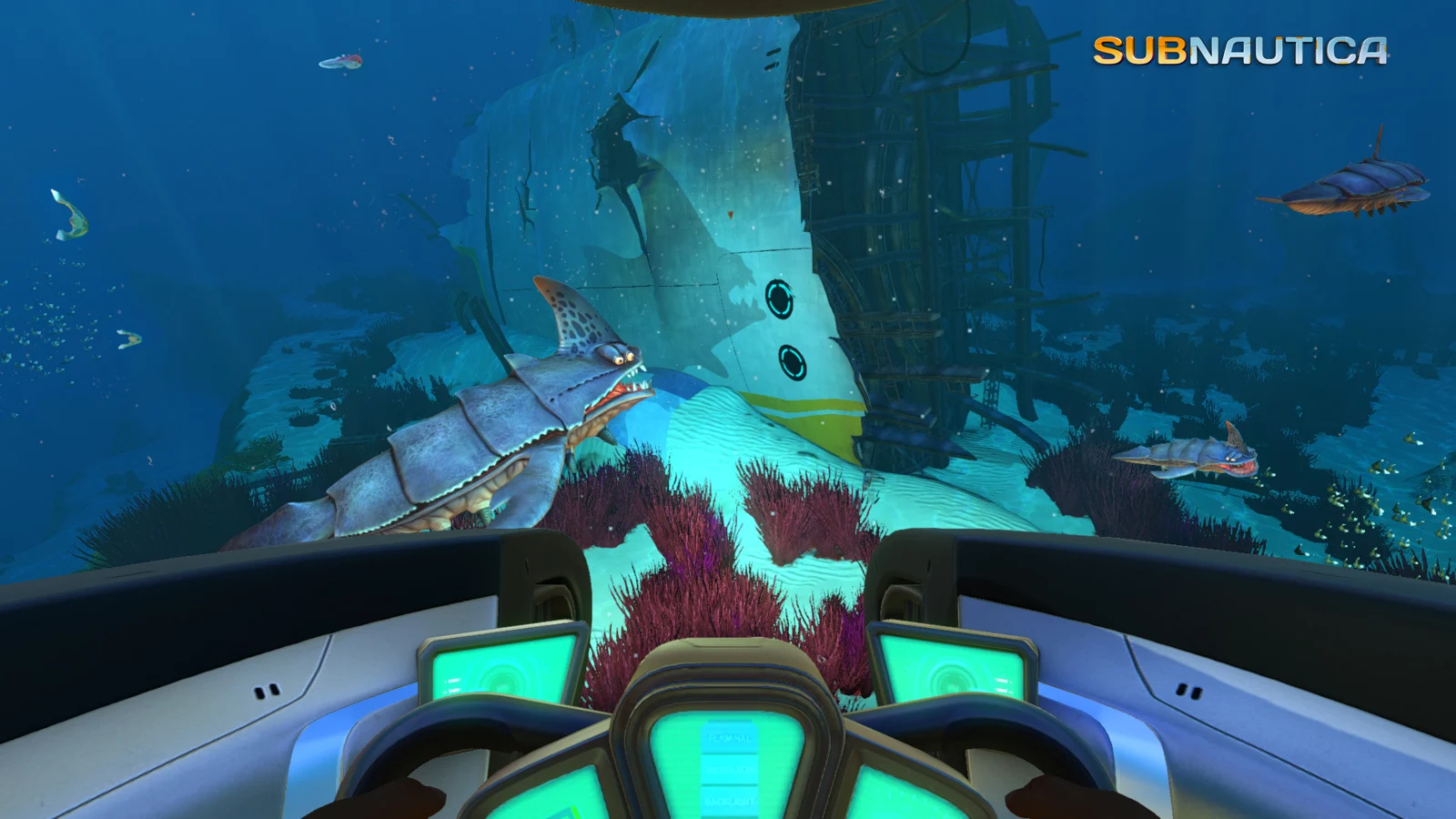
Notice the transition rather than the label
An unfamiliar biome often announces itself before you know its name. The plants change, the seabed opens or falls away, and the light takes on another character. Treat that transition as something to observe rather than a line you must cross immediately. The edge of a place can teach you how to recognise it on a later visit.
Pause on the familiar side and describe what changed. A single colour difference may not be enough, but several visual clues together can make the boundary legible. You are building a relationship between appearance and route. That is more useful than collecting names from a map while the corresponding places still look anonymous in the water.
Read foreground, middle distance and exit
A clear view has layers. Nearby terrain tells you where you can move immediately, the middle distance suggests the area you are approaching, and the visible way back keeps the excursion connected to familiar ground. Check all three before concentrating on one interesting object ahead. A dramatic panorama can conceal how much the return route has changed.
Use the terrain to decide how far this particular outing should go. A boundary visit can be a complete expedition if its purpose is to understand the approach. You do not need to reach the deepest visible point merely because the scene makes it tempting. Returning with a readable route is useful preparation for a later, better-equipped exploration.
Separate an animal from an assumption
An unfamiliar silhouette deserves attention, but appearance alone is not a complete account of behaviour. Observe from a position where you can still leave comfortably. Notice movement and distance without turning every encounter into an immediate attempt to get closer. Curiosity works best when you continue to understand the surrounding water.
The scanner and databank can support that observation when a sensible opportunity appears. They do not require you to finish every investigation during the first sighting. If the situation feels uncertain, mark or remember the approach and return later. The journal can record a question that remains open instead of replacing it with an untested claim about what the animal will always do.
Compare equipment with the route
Before a second visit, ask which part of the first approach limited you. It may have been oxygen, a tool's remaining power, the need to find the route again or simply a lack of familiarity with the terrain. Different limitations suggest different preparations. Buying or crafting an upgrade without naming the problem can leave the expedition just as unclear.
Read depth and equipment limits in your own game. This is especially important once vehicles enter your routine: their presence changes the possibilities but does not make every route appropriate. An expedition plan should use the capability you have, not the capability you hope the next piece of technology will eventually provide.
Keep the journal spoiler-light
Write about what makes the approach recognisable and what you intend to check next. Leave major discoveries to the game. A useful boundary note might mention a change in vegetation and a clear return reference without listing everything beyond it. That preserves the sense of an unfolding ocean while still giving your next outing a practical starting point. You can become a more prepared explorer without reading ahead of your own curiosity.